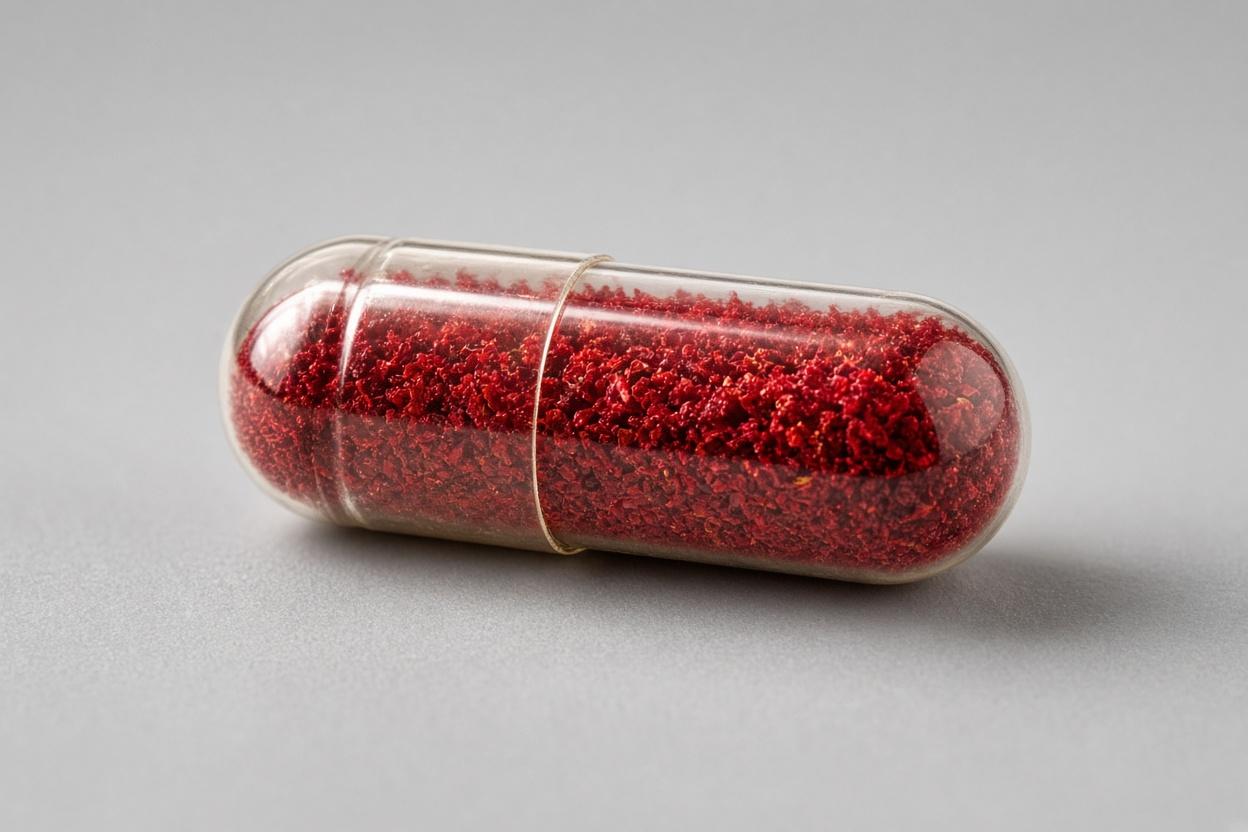
Most mood and worry studies used a standardized saffron extract from the red threads, often about 28 to 30 milligrams a day. Duration was commonly four to twelve weeks. The people enrolled were usually adults with mild-to-moderate low mood, or with symptoms short of a severe diagnosed illness. Some trials compared saffron with placebo. A smaller number sat it beside a standard antidepressant. That pattern is not every trial. One 2016 anxiety trial used 50 milligrams twice a day. The sleep trials used other amounts, and they asked a different question.
Mood
Self-report mood scores often came out lighter than placebo.
A 2026 review of 34 randomized trials and 1,769 adults found Beck depression scores lower across 14 trials and 817 people, a weighted mean difference of −4.39 (confidence interval −6.64 to −2.15). The Hamilton depression scale, which a clinician scores, did not show a clear change once those trials were combined. A 2024 review of 46 randomized trials, not all of them depression trials, found a depression effect against placebo of −4.26 (confidence interval −5.76 to −2.77). These are averages across groups. One person can land elsewhere. The depression room holds the pools, the guidelines, and the trials that did not move.
PubMed 41693488 · PubMed 38424688 · The depression trials
Worry
The form you fill in often moved. The clinician form often did not.
In that 2026 review, Beck anxiety scores were lower across 6 trials and 339 people, a weighted mean difference of −5.06 (confidence interval −8.44 to −1.68). The Hamilton anxiety scale did not show a clear effect once the trials were combined. The 2024 review found an anxiety effect against placebo of −3.75 (confidence interval −5.83 to −1.67), and those 46 trials were not all anxiety trials. The anxiety room keeps both halves.
PubMed 41693488 · PubMed 38424688 · The anxiety trials
Stress
The trial that measured stress did not find a clear difference.
In 2025, 202 adults with subclinical low mood took 28 milligrams a day of a standardized stigma extract the paper calls Affron, or a placebo, for 12 weeks. The abstract gives a lighter depression score on the DASS-21. On the other measures it collected, which included anxiety and stress, it reports no clear difference between the groups. The authors said the placebo response was large. A separate trial of 51 adults used about 30 milligrams a day for six weeks. Its main result was a combined score of depression, anxiety, and fatigue, and that score did not clearly change. A stress improvement is not what these two papers report.
PubMed 40414301 · PubMed 41047129
Beside an antidepressant
A small gap in the scores is not proof the two are equal.
Eight depression studies against SSRIs found a standardized mean difference of 0.10 (confidence interval −0.09 to 0.29). Four anxiety studies found 0.04 (confidence interval −0.22 to 0.29). In that same SSRI review, people taking saffron reported fewer adverse events, a risk difference of −0.06. The authors of some reviews have called saffron a possible alternative. This page does not. A handful of small studies that fail to find a difference are not a reason to set a prescribed medicine down.
PubMed 38913392 · Depression · Anxiety
Sleep
Some sleep questionnaires improved. That is a different room.
Two placebo trials in adults with self-reported sleep complaints found better questionnaire sleep quality than placebo. They were not enrolled as people with a diagnosed sleep disorder. One evening trial also rated mood after waking. Those papers do not show that better sleep is why a mood score moved. The doses were 14 milligrams twice a day, or 14 or 28 milligrams in the evening. The sleep room holds them.
saffronsleep.com
Timing
The scores were read after weeks, not after one dose.
About six weeks is the length a 2026 depression review keeps meeting. The 2025 Affron trial ran 12 weeks. Other saffron trials run from four weeks out to forty-eight, so several weeks is common, not a rule for every study. That is a description of the study calendar. It is not an instruction to take an extract every day.
PubMed 41939549 · PubMed 40414301